Skip to content

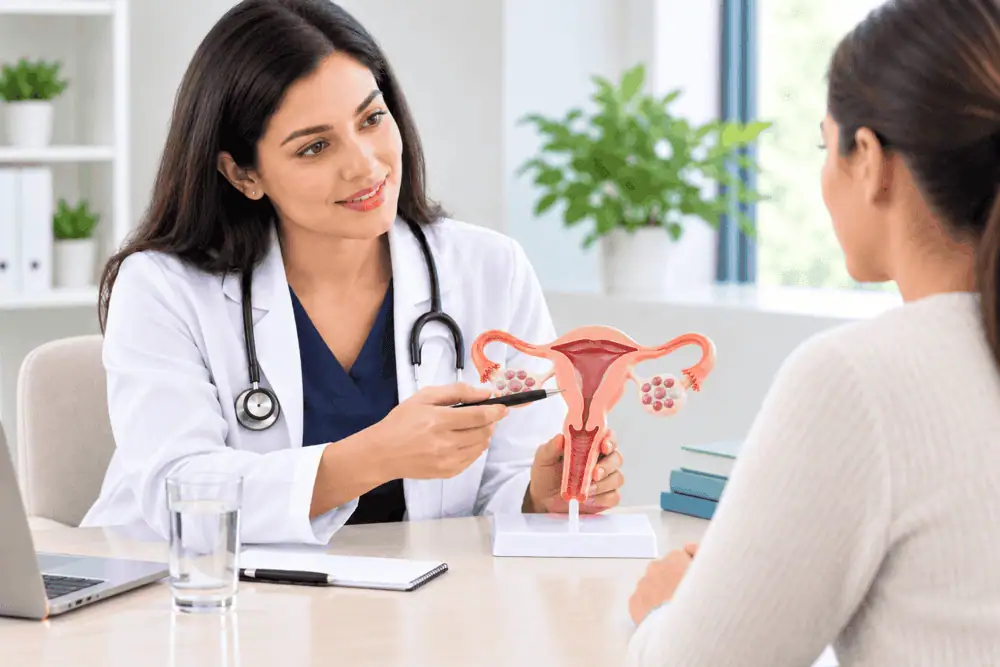
If your period arrives whenever it feels like it, you have probably been told it is stress, or your weight, or just how your body works. That answer never explains much, and it leaves you tracking a cycle you cannot predict.
Here is the short version. An irregular menstrual cycle in PCOS signals that ovulation is inconsistent or absent, and ovulation stalls because of a hormone imbalance that starts with insulin.
Why does PCOS make monthly bleeding so unpredictable?
PCOS disrupts ovulation, the event that normally sets the schedule for a period. In most cases, insulin resistance prompts the ovaries to produce excess androgens, and that excess interferes with the follicle maturation needed to release an egg. Without ovulation, there is no progesterone rise to signal the uterine lining to shed on time, so timing typically becomes unpredictable.
What Irregular Periods Actually Signal
Irregular periods point to a timing problem in the hormonal signals that run your cycle, not a problem with the uterus itself. A typical cycle falls between 21 and 35 days, so consistently landing outside that window, having fewer than eight periods a year, or going several months with nothing at all counts as irregular.
Several things can cause that drift, including thyroid dysfunction and elevated stress hormones, though PCOS is among the most common causes in women of reproductive age. Worth naming honestly: plenty of women assume unpredictable cycles are simply normal, especially if it’s been that way since their teens, and that assumption is why the pattern often goes years without a real look.
How PCOS Affects Hormones
PCOS is a hormonal and metabolic disorder, not only a reproductive one, which is why it shows up in androgen levels, blood sugar, mood, and body composition rather than staying confined to the ovaries. The name causes confusion too. The small follicles visible on an ultrasound result from stalled ovulation, not the cause, and cysts are not required for a diagnosis.
The reproductive hormones involved work as a system. Insulin, testosterone, and DHEA sit at the center, luteinizing hormone (LH) and follicle-stimulating hormone (FSH) carry the ovulation signal, and thyroid and cortisol shape the picture from the outside. Because they influence one another, a diagnosis rests on a full clinical evaluation rather than a single lab value or one ultrasound finding.
The Insulin Connection Most Explanations Skip
Insulin is where the chain begins. Insulin resistance means your cells respond poorly to insulin, so the pancreas compensates by producing more of it. Blood sugar can look normal on a basic panel while insulin runs high in the background, sometimes for years.
That elevated insulin does two things at once:
- It signals the ovaries to produce more androgens.
- It lowers sex hormone-binding globulin, the protein that keeps testosterone bound and inactive.
So the body makes more androgens, and more of them circulate freely. Excess androgen then interferes with follicle maturation. Follicles begin developing but do not reach the point of releasing an egg.
One correction worth making: insulin resistance is common at a normal body weight. Weight does not rule PCOS in or out.
Why Ovulation Drives Cycle Timing
Ovulation sets the clock on a period. When an egg is released, the remaining follicle produces progesterone, and when progesterone drops, the lining sheds.
Without ovulation, there is no progesterone rise and no clean signal to shed. Estrogen keeps building the lining with nothing to balance it, which is why cycles swing between long gaps and unusually heavy periods when they finally arrive.
That is also the honest context for birth control, often the first thing offered. It can produce a predictable monthly bleed, but it does so by overriding the cycle rather than correcting what is underneath. Not an argument against it, just a reason to make that call with a physician who has seen your full picture.
The Symptoms That Share the Same Root
Most symptoms that travel alongside irregular cycles come from the same two drivers. Once you know the mechanism, they stop looking like a random collection of complaints.
- Jawline acne, facial hair, and thinning at the scalp trace back to androgen excess. These are hormonal signals, not cosmetic problems.
- Abdominal weight that resists standard diet and exercise traces back to insulin resistance.
- Anxiety, low mood, and brain fog are commonly reported and connect to hormonal fluctuation alongside cortisol patterns.
How much of this shows up varies widely from patient to patient, which is a major reason the condition is missed or only partially treated.
What a Complete Hormonal Evaluation Looks At
Effective PCOS treatment starts with an evaluation that measures the metabolic driver directly rather than inferring it. A standard workup covers LH, FSH, testosterone, and an ultrasound. That is a reasonable starting point, but it stops short of explaining why ovulation stalled.
At Restoration Health 365, the evaluation for PCOS treatment in Jericho, NY adds fasting insulin, glucose, HbA1c, and a lipid panel to assess insulin resistance on its own terms. It also looks at:
- Thyroid function and cortisol tracked across the full day, not a single morning draw
- Inflammatory markers, which both drive and result from the condition
- Vitamin D, B12, magnesium, and iron, each of which affects hormone regulation
- Body composition, since abdominal fat distribution acts as both symptom and driver
When hormonal support is appropriate, we build that plan from these results and supervise it with a physician through an individualized approach to hormone balance.
This broader scope identifies contributors a standard workup can miss. It is not a replacement for the care your gynecologist provides.
Your Cycle Is Telling You Something Worth Investigating
Irregular periods are the visible readout of a hormonal and metabolic pattern, not a standalone problem to manage on its own. If years of unpredictable cycles have never come with an explanation that fits, the missing piece is usually data no one has gathered yet.
Our physician-led team in Jericho looks at the full picture behind your menstrual health, from insulin and androgens to thyroid, cortisol, and the nutrient levels that shape hormone regulation. Get answers about your hormonal health with a comprehensive physician-led evaluation. Schedule today.